Certifying randomness with an entangled-photon source
Characterising a Type-II PPKTP polarization-entangled source with a Bell test, visibility curves and tomography, then using it to generate random bits.
- Setting
- Quantum Optics & Quantum Information Lab, Department of Instrumentation and Applied Physics, IISc Bengaluru
- Period
- Sep 2023 – Apr 2024
- Thesis
- Entanglement certified quantum random number generation using polarisation entangled photons. BS (Research) thesis, Department of Instrumentation and Applied Physics, IISc. Supervisor: C. M. Chandrashekar.
Problem
A random number generator is only as trustworthy as the evidence that its output comes from a quantum process. This thesis asks how the quality of random bits drawn from entangled photons relates to the quality of the entanglement, and how a Bell violation can certify that the data are quantum.
Method
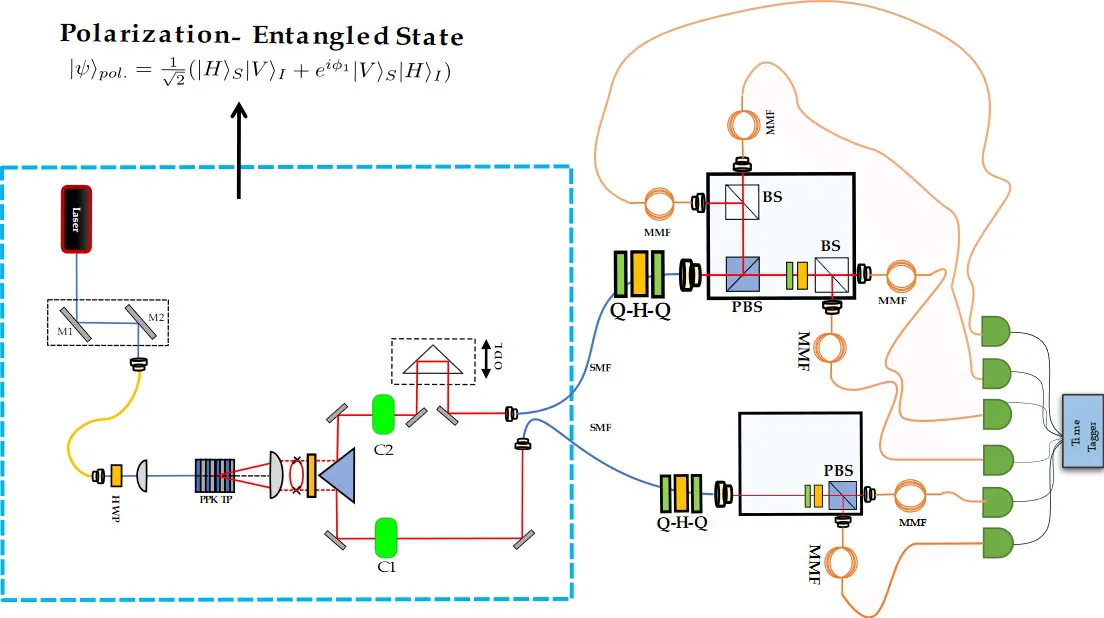
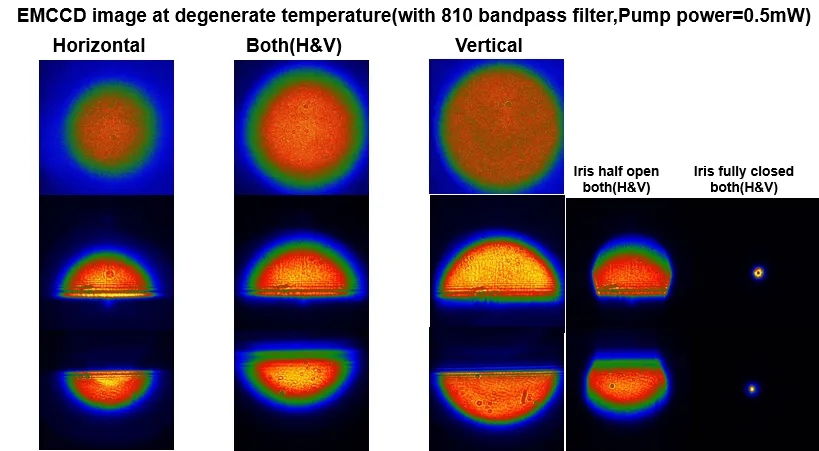
Photon pairs come from spontaneous parametric down-conversion in a 10 mm type-II PPKTP crystal with quasi-phase matching. The down-converted light cones were imaged with an EMCCD camera. Entanglement was checked three ways:
- a Bell–CHSH test from coincidence counts at four pairs of polarizer settings,
- polarization-correlation visibility curves with the first polarizer at H, D, V and A,
- quantum state tomography, giving Stokes parameters, the density matrix and the state fidelity.
The CHSH value combines four correlations, each computed from four coincidence counts:
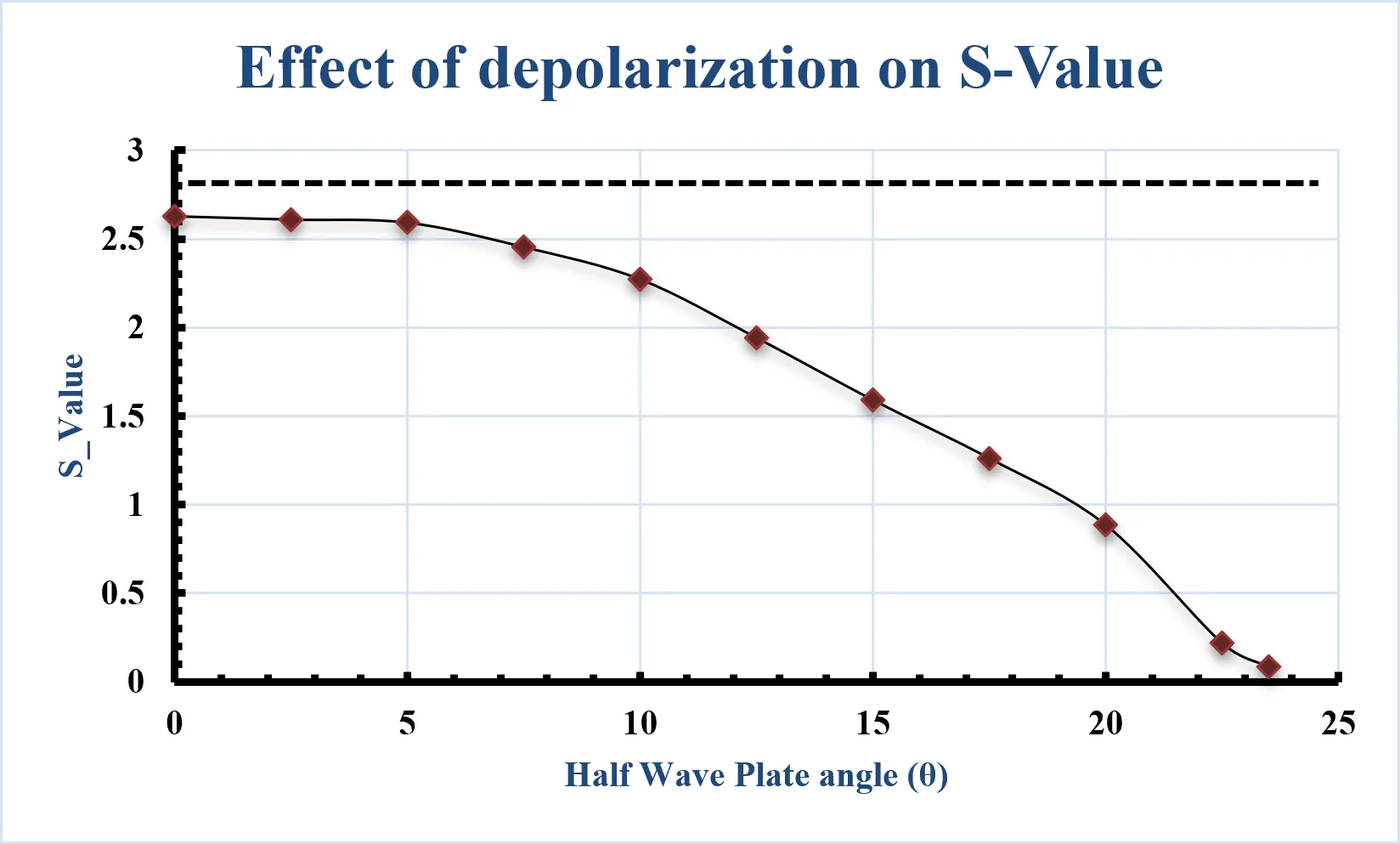
Random bits come from measuring the polarization of one photon. The thesis tests them with the NIST suite, splits them into odd and even bits, applies Toeplitz and XOR extractors, and studies how depolarization with a half-wave plate lowers both S and the randomness.
Reported results
The thesis reports 2.729measured from the Table 5.1 counts, above the local bound of 2, a state fidelity of 93.9%measured from tomography, and a bit rate of 138 kbpsmeasured at 6 mW pump power, with the bits passing 15 NIST tests without post-processing.
The four-qubit QRNG paper reports its own characterisation of the source it used. Those numbers are on that case study and are not combined with the thesis values here.
| Quantity | Value | Kind | Source |
|---|---|---|---|
| CHSH value SComputed from the coincidence counts in Table 5.1 | 2.729 | measured | Verma, BS thesis, IISc (2024), Table 5.1, p. 41QuoteS 2.729230425 |
| State fidelity from tomography | 93.9% | measured | Verma, BS thesis, IISc (2024), Sec. 5.3, p. 44QuoteFIDELITY 93.9 |
| Random bit rateAt 6 mW pump power | 138 kbps | measured | Verma, BS thesis, IISc (2024), abstractQuoteWith a 6mW pump power, we achieve a 138kbps bitrate |
| NIST randomness tests passedWithout post-processing | 15 | measured | Verma, BS thesis, IISc (2024), abstractQuoteThese quantum random numbers generated using this method pass 15 NIST tests for randomness without post-processing. |
Explore
Visibility curves
- H (0°)
- 4,578
- D (45°)
- 2,352
- V (90°)
- 24
- A (135°)
- 2,103
The Bell test, from the raw counts
Pick one of the four correlation terms to see which counts it uses.
| −22.5°HWP 168.75° | 22.5°HWP 11.25° | 67.5°HWP 33.75° | 112.5°HWP 56.25° | |
|---|---|---|---|---|
| −45°HWP 157.5° | 27,319 | 131,471 | 127,049 | 19,625 |
| 0°HWP 0° | 138,251 | 129,374 | 23,568 | 29,161 |
| 45°HWP 22.5° | 146,541 | 27,491 | 23,705 | 138,523 |
| 90°HWP 45° | 22,855 | 29,479 | 138,257 | 127,481 |
E(−45°, −22.5°) = (27,319 + 23,705 − 127,049 − 146,541) / (sum of all four) = −0.6856counted positively counted negatively
E(−45°, 22.5°) = (131,471 + 138,523 − 19,625 − 27,491) / (sum of all four) = 0.7028counted positively counted negatively
E(90°, −22.5°) = (22,855 + 23,568 − 138,251 − 138,257) / (sum of all four) = −0.7125counted positively counted negatively
E(90°, 22.5°) = (29,479 + 29,161 − 129,374 − 127,481) / (sum of all four) = −0.6283counted positively counted negatively
S = |E₁ − E₂ + E₃ + E₄| = |−0.6856 − (0.7028) + (−0.7125) + (−0.6283)| = 2.729
Computed from the thesis counts when this page was built; it reproduces the thesis value S = 2.729 (Table 5.1). The local bound is 2 and the Tsirelson bound is 2√2 ≈ 2.83.
Reconstructed state
| |HH⟩ | |HV⟩ | |VH⟩ | |VV⟩ | |
|---|---|---|---|---|
| |HH⟩ | 0.01 | 0.02 | 0.04 | −0.00 |
| |HV⟩ | 0.02 | 0.54 | 0.45 | −0.04 |
| |VH⟩ | 0.04 | 0.45 | 0.44 | −0.01 |
| |VV⟩ | −0.00 | −0.04 | −0.01 | 0.01 |
| |HH⟩ | |HV⟩ | |VH⟩ | |VV⟩ | |
|---|---|---|---|---|
| |HH⟩ | 0.00 | 0.02 | −0.06 | −0.22 |
| |HV⟩ | −0.02 | 0.00 | 0.00 | 0.05 |
| |VH⟩ | 0.06 | −0.00 | 0.00 | −0.02 |
| |VV⟩ | 0.22 | −0.05 | 0.02 | 0.00 |
Two-photon polarization state reconstructed by tomography (thesis Table 5.5), shown to two decimals. Shade tracks magnitude; hatched cells are negative. The large |HV⟩ and |VH⟩ populations, and the coherence of 0.45 between them, stand out. Fidelity reported in the thesis: 93.9%.
Figures
My contribution
This thesis gave me a working understanding of the entangled-photon source and hands-on experience with it and its measurements. Building the source was not my work alone.
Author’s statement, October 2026.
I wrote and submitted the thesis.
Thesis declaration, April 2024.
Collaborators
C. M. Chandrashekar supervised the thesis. Members of the Quantum Optics and Quantum Information lab are thanked in the acknowledgements; their individual roles are not stated.
BS thesis, certificate and acknowledgements.
Thesis
Entanglement certified quantum random number generation using polarisation entangled photons. BS (Research) thesis, Department of Instrumentation and Applied Physics, IISc. Supervisor: C. M. Chandrashekar.