Publicly verifiable randomness from four photonic qubits
Polarization- and path-entangled photon pairs prepare a four-qubit state whose outcomes can be checked in public while two bit strings stay secret.
- Setting
- Quantum Optics & Quantum Information, Department of Instrumentation and Applied Physics, IISc Bengaluru
- Period
- Published 2024
- Paper
- Physical Review A 110, 032615 (2024)
- Authors
- Mayalakshmi Kolangatt, Anirudh Verma, Sujai Matta, Kanad Sengupta, C. M. Chandrashekar
Problem
Most random numbers in practice come from algorithms, which are predictable to anyone who knows the algorithm and its seed. Quantum measurements give genuine randomness, but statistical tests alone cannot show where a sequence came from, and testing a sequence normally means revealing it.
This work asks how to let an outside party verify the randomness of a quantum device in real time while the bits actually used stay secret, and how to generate public and private keys from the same system.
Method
The protocol uses a four-qubit state that is an equal superposition of all even-parity strings, Eq. (2) of the paper:
Measuring each qubit gives four bit strings that are pairwise independent but tied by a parity rule, Eq. (5):
Discarding one string breaks that link, leaving three independent strings. Publishing one for randomness testing then certifies the other two without revealing them, so n published bits verify 2n secret bits.
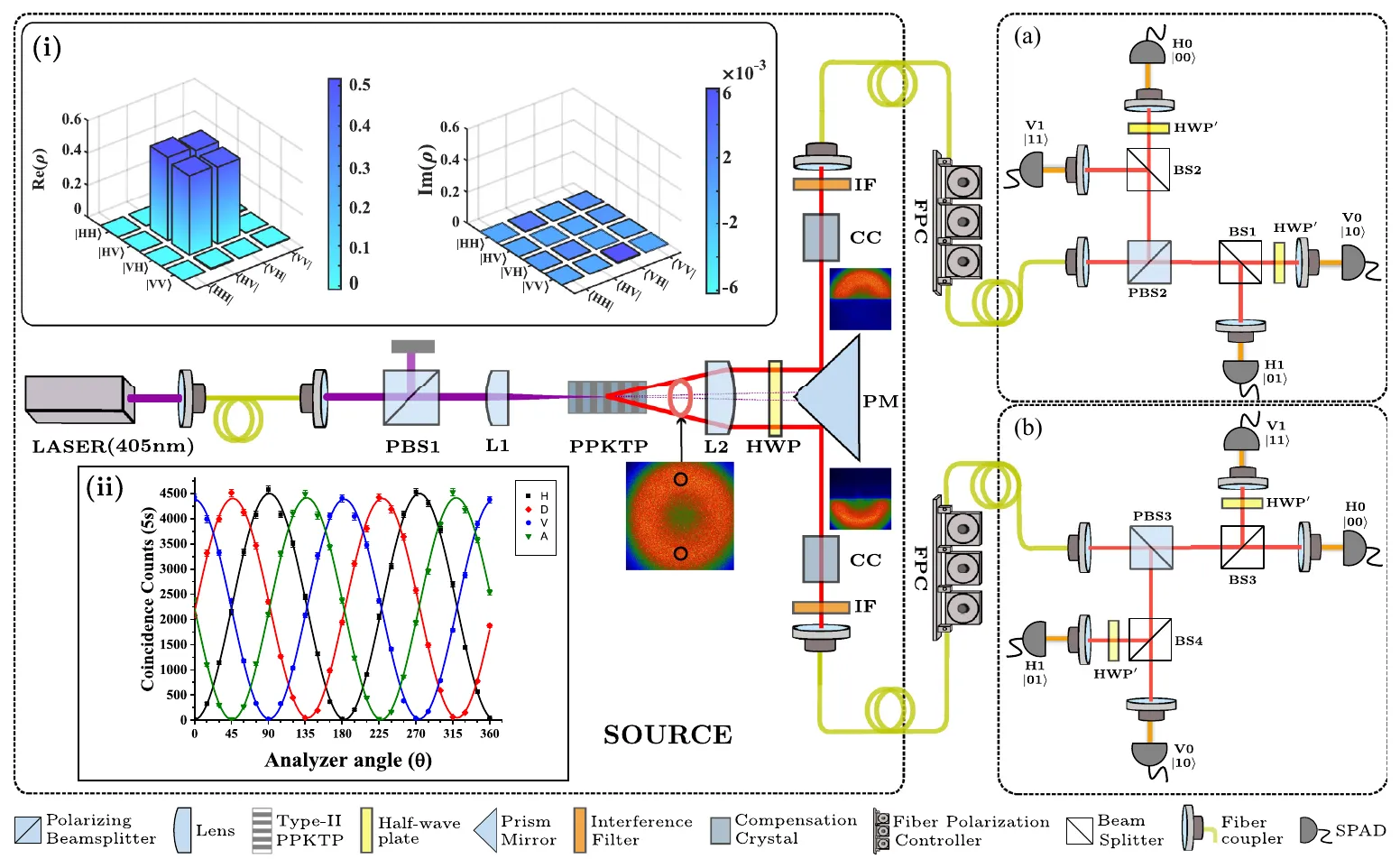
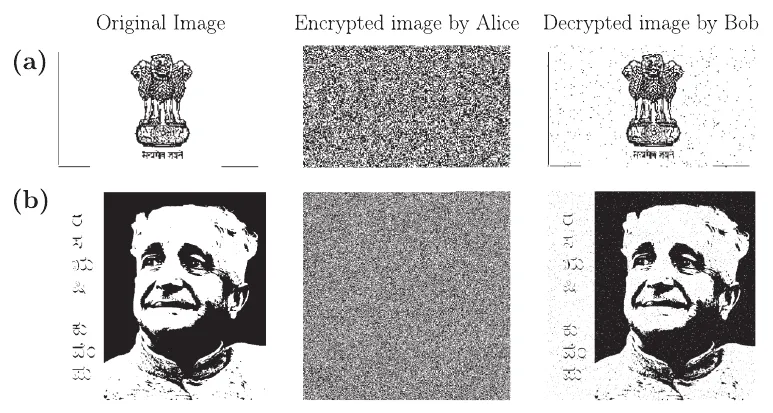
In the experiment, polarization-entangled photon pairs come from a type-II PPKTP crystal pumped at 405 nm. Beam splitters add a path qubit to each photon, giving a four-qubit polarization–path state read out by eight single-photon detectors and a time tagger. The same outputs give Alice and Bob simultaneous public and private keys, demonstrated by encrypting and decrypting images. A noise model, applied to the two-photon input state, describes how entanglement variation and depolarizing noise change the bit rate.
Reported results
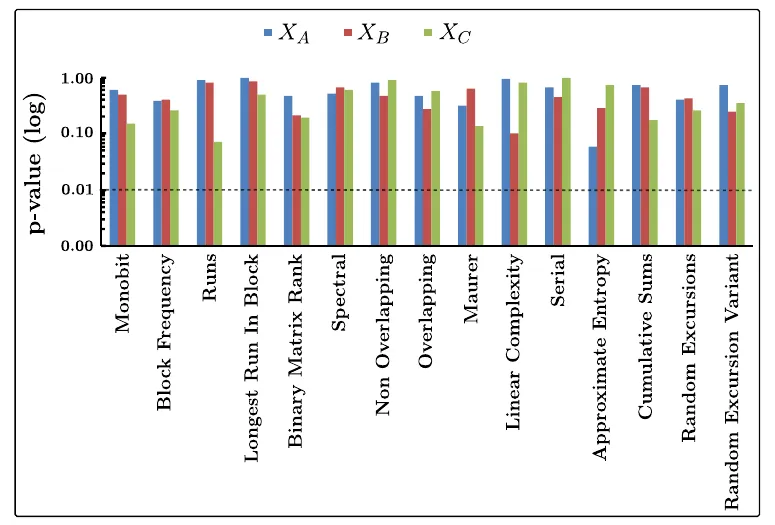
The system produced publicly verified and secured random bits at 185 kbpsmeasured, from a collective rate of 370 kbps at 6 mW pump power. Of the sampled bits, 97.9%measured passed entanglement verification, and all strings passed 15 of 15 NIST tests without post-processing.
| Quantity | Value | Kind | Source |
|---|---|---|---|
| Publicly verified and secured random bitsFrom collective data of 370 kbps | 185 kbps | measured | Kolangatt et al., Phys. Rev. A 110, 032615 (2024), abstractQuotewe generate publicly verified and purely secured random bits at the rate of 185 kbps from collective data of 370 kbps. |
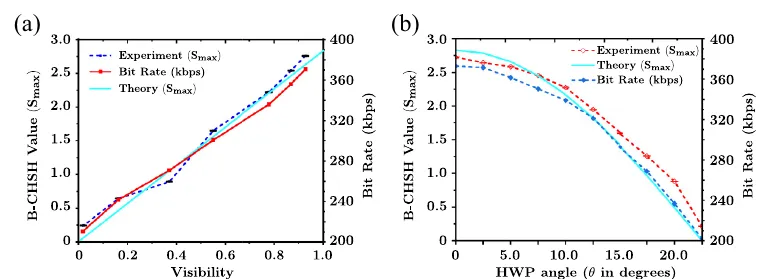
| Collective bit rateAt 6 mW pump power | 370 kbps | measured | Kolangatt et al., Phys. Rev. A 110, 032615 (2024), Sec. III AQuoteAt a pump power of 6 mW, we reached a bit rate of 370 kbps |
| Sampled bits passing entanglement verification, Eq. (5)10% of recorded strings (3 330 856 bits) used as the sample | 97.9% | measured | Kolangatt et al., Phys. Rev. A 110, 032615 (2024), Sec. III CQuoteWe used 10% of the recorded strings, consisting of 3 330 856 bits, to verify if the outputs satisfy the condition in Eq. (5). Of the sample data, 97.9% met the condition. |
| NIST SP 800-22 tests passedAll four strings, no post-processing | 15 of 15 | measured | Kolangatt et al., Phys. Rev. A 110, 032615 (2024), Sec. III AQuoteAll the strings XA, XB, XC, and XD of the generated random numbers passed all 15 NIST tests without any need for postprocessing. |
| Fidelity of the entangled photon source stateReconstructed density matrix | 98.12% | measured | Kolangatt et al., Phys. Rev. A 110, 032615 (2024), Fig. 3 captionQuoteShows the real and imaginary parts of the reconstructed density matrix of the entangled photons with fidelity 98.12% |
| Source visibility, H/V and A/D basesTaken at 0.15 mW pump power | 98.6% and 98.1% | measured | Kolangatt et al., Phys. Rev. A 110, 032615 (2024), Fig. 3 caption and Sec. IIIQuotevisibility plot in H/V (98.6%) and A/D (98.1%) basis. … Data were taken at a lower pump power of 0.15 mW so that the accidental counts were minimal |
| CHSH value of the source photon pairs | 2.77 | measured | Kolangatt et al., Phys. Rev. A 110, 032615 (2024), Sec. IVQuoteThe entangled source photon pairs used for the generation of four-qubit state and randomness generation gives a Bell's CHSH value of 2.77 |
| Noise model vs. measured bit ratesEntanglement variation and depolarizing noise, Figs. 6–7 | agreement reported | model | Kolangatt et al., Phys. Rev. A 110, 032615 (2024), abstractQuoteThe theoretical model of noise on the four-qubit state and its effect on the generation rate of verified and secured bits are in perfect agreement with the experimental results. |
Explore
The sampler draws outcomes from the ideal state above and splits them as the protocol does: one string published, two kept secret, one discarded.
Simulated draws from the ideal state, Eq. (2), using your browser's random numbers. This shows how the protocol splits the four bit strings; it is not experimental output.
XA published for randomness testing
XB kept secret
XC kept secret
XD discarded
No measurements yet.
For the ideal state the parity rule always holds. In the experiment, 97.9% of the sampled bits satisfied it.
Figures
My contribution
I worked on the theory, data collection, noise modelling and testing.
Author’s statement, October 2026.
Collaborators
Mayalakshmi Kolangatt (first author), Sujai Matta, Kanad Sengupta and C. M. Chandrashekar. The paper does not state individual author roles.
Author list, Phys. Rev. A 110, 032615.
The paper thanks K. Muhammed Shafi for input on the design of the experimental setup, and M. Joshi for contributing to building the entangled photon source.
Acknowledgments, Phys. Rev. A 110, 032615.