Simulating PR-box correlations without signalling
A four-qubit photonic circuit that reproduces Popescu–Rohrlich correlations using a resource that cannot be used to signal.
- Setting
- Quantum Optics & Quantum Information Laboratory, IISc Bengaluru, with S. N. Bose National Centre for Basic Sciences, Kolkata
- Period
- Preprint, 2025
- Paper
- Under review, npj Quantum Information; arXiv:2509.26271 (status as of September 2026)
- Authors
- Kunal Shukla, Anirudh Verma, Kanad Sengupta, Sanchari Chakraborti, Manik Banik, C. M. Chandrashekar
Problem
Quantum correlations violate Bell inequalities, but only up to a point. For the CHSH expression, parties sharing any entangled state cannot exceed Tsirelson’s bound of 2√2, while the no-signalling principle alone would allow the algebraic maximum of 4. The Popescu–Rohrlich (PR) box reaches that maximum.
PR correlations can be simulated if the parties may communicate, which defeats the point. This work asks whether they can be simulated using a resource that is intrinsically non-signalling, and demonstrates this on a photonic circuit.
Method
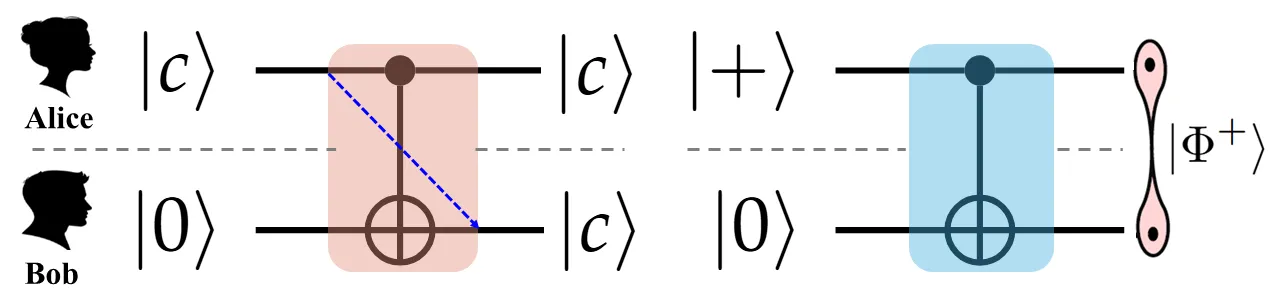
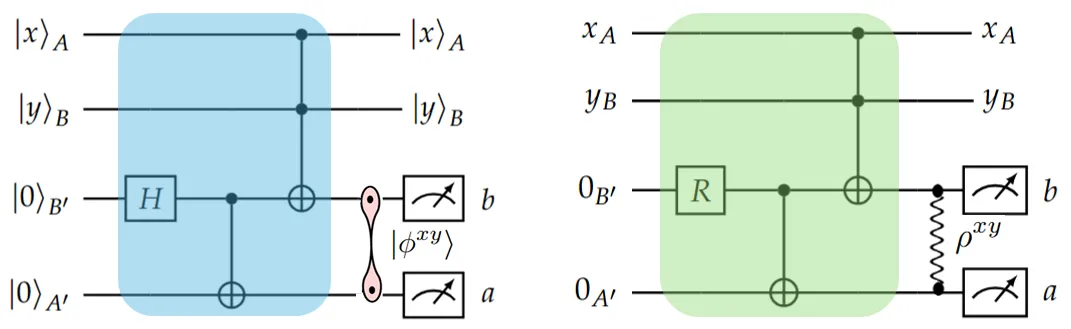
In the circuit picture, an entangling gate can act as a signalling or a non-signalling resource depending on how its inputs are prepared (Fig. 1). The scheme combines Hadamard, CNOT and Toffoli gates into a four-qubit oracle with restricted input access. The gate controls correlations between distinct physical systems, while randomness inside the gate removes any signalling capacity (Fig. 2).
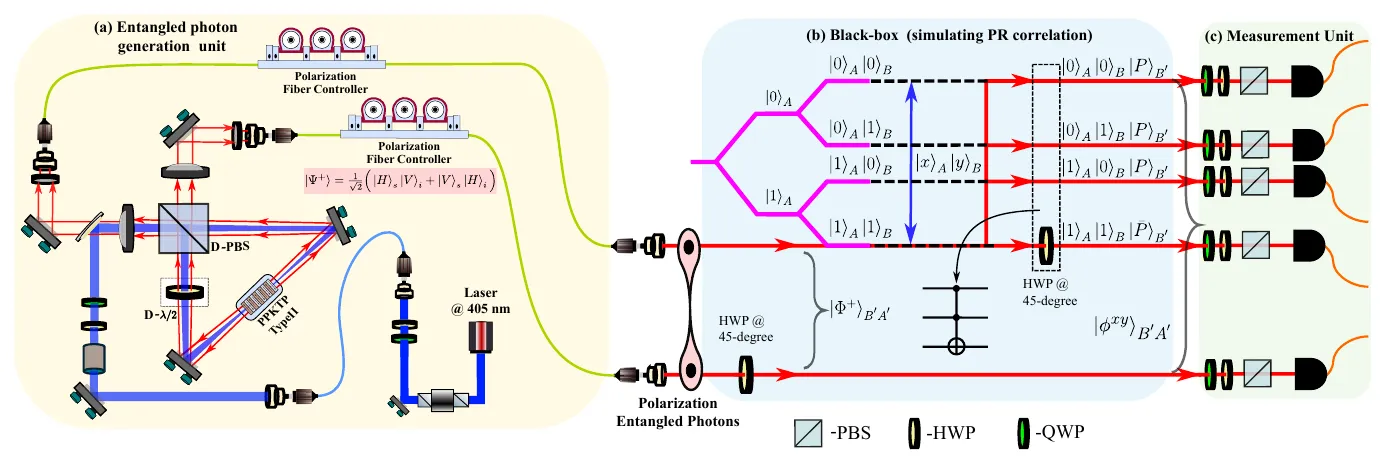
The experiment uses a polarization-entangled photon pair from a type-II PPKTP crystal in a Sagnac interferometer, with polarization and path encoding on each photon (Fig. 4). The CHSH value is computed from coincidence counts:
A numerical simulation repeats the scheme with an unentangled, classically correlated state, and the Supplementary Material of the paper extends it to multipartite correlations.
Reported results
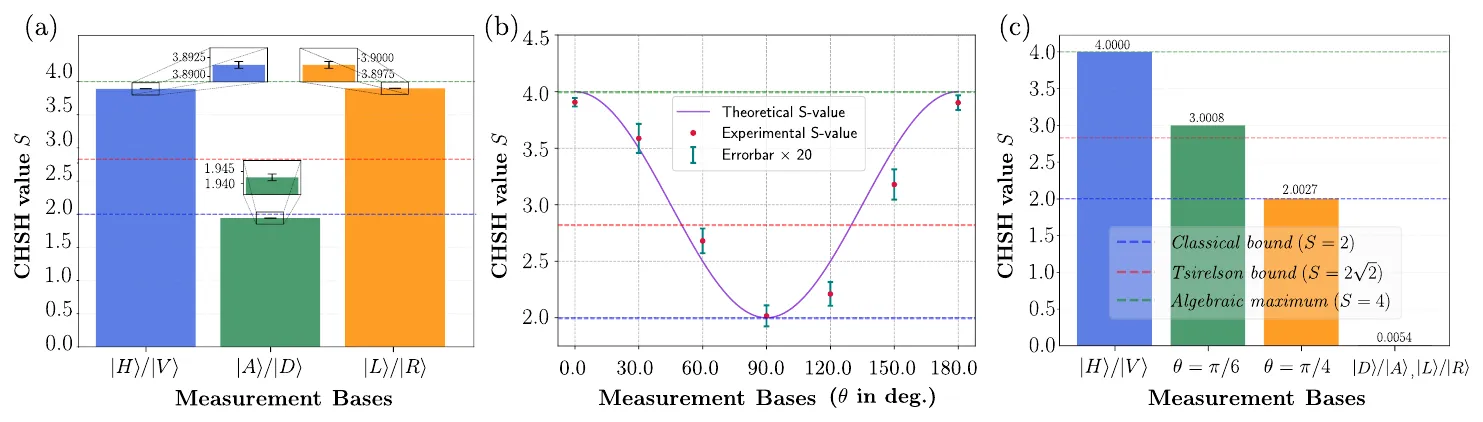
The measured CHSH value is 3.91 ± 0.002measured, against an ideal of 4. For reference, the local bound is 2, the Tsirelson bound 2√2 ≈ 2.83 and the algebraic maximum 4. These are values from theory, not measurements.
In the computational and circular measurement bases the measured values approach 4, while the diagonal basis gives at most 2. The paper also reports that, in simulation, PR correlations are reproduced without entanglement.
| Quantity | Value | Kind | Source |
|---|---|---|---|
| CHSH value S in the PR-correlation simulationFour-qubit photonic circuit acting as a non-signalling oracle. Ideal value 4. | 3.91 ± 0.002 | measured | Shukla et al., arXiv:2509.26271v1, p. 5, after Eq. (7)QuoteUnder ideal conditions the expected value is S = 4; in our setup we obtain S = 3.91 ± 0.002, close to the maximum achievable value. |
| Local (classical) bound on S | 2 | theoretical bound | Shukla et al., arXiv:2509.26271v1, Fig. 3(c) legendQuoteClassical bound (S = 2) |
| Tsirelson (quantum) bound on S | 2√2 ≈ 2.83 | theoretical bound | Shukla et al., arXiv:2509.26271v1, Fig. 3(c) legendQuoteTsirelson bound (S = 2√2) |
| Algebraic maximum of S (PR box) | 4 | algebraic limit | Shukla et al., arXiv:2509.26271v1, Fig. 3(c) legendQuoteAlgebraic maximum (S = 4) |
| Fidelity of the two-qubit maximally entangled stateState generated by the photonic circuit | 93.9% | measured | Shukla et al., arXiv:2509.26271v1, pp. 1–2QuoteWe realize a photonic circuit that generates a two-qubit maximally entangled state with fidelity 93.9% |
| VisibilityAcross multiple measurement bases | > 99% | measured | Shukla et al., arXiv:2509.26271v1, p. 2Quote…and with visibilities above 99% across multiple bases. |
| S in the diagonal basis {|A⟩, |D⟩}Computational and circular bases approach 4 | at most 2 | measured | Shukla et al., arXiv:2509.26271v1, Fig. 3(a) captionQuoteComputational basis measurement {|H⟩, |V⟩} and circular basis measurement {|L⟩, |R⟩} approach the algebraic maximum S = 4 (PR correlations), whereas diagonal basis {|A⟩, |D⟩} attains at most S = 2. |
| PR correlations from an unentangled, classically correlated stateNumerical simulation, Fig. 3(c) | reproduced | simulated | Shukla et al., arXiv:2509.26271v1, p. 2Quotenumerical simulations confirm that PR correlations can be obtained without entanglement, but through the preparation of classically correlated states |
Explore
Measured S = 3.91 ± 0.002
The target correlation
A PR box returns outputs with for every pair of inputs, while each output on its own is a fair coin. Draw from an ideal box to see both properties.
Illustration of the ideal PR box, the target correlation. Sampled with your browser's random numbers; not experimental data.
Choose inputs and draw. Each draw gives Alice a random bit a, and Bob b = a ⊕ (x · y).
| x, y | Draws | a ⊕ b = x · y | Bob's b = 1 |
|---|---|---|---|
| 0, 0 | 0 | – | – |
| 0, 1 | 0 | – | – |
| 1, 0 | 0 | – | – |
| 1, 1 | 0 | – | – |
With every round won, the CHSH combination of correlators reaches its algebraic maximum of 4.
Figures
My contribution
I worked on the initial part of the theory and on the analysis.
Author’s statement, October 2026.
Collaborators
Kunal Shukla (first author), Kanad Sengupta, Sanchari Chakraborti, Manik Banik and C. M. Chandrashekar. The paper does not state individual roles.
Author list of arXiv:2509.26271v1.